
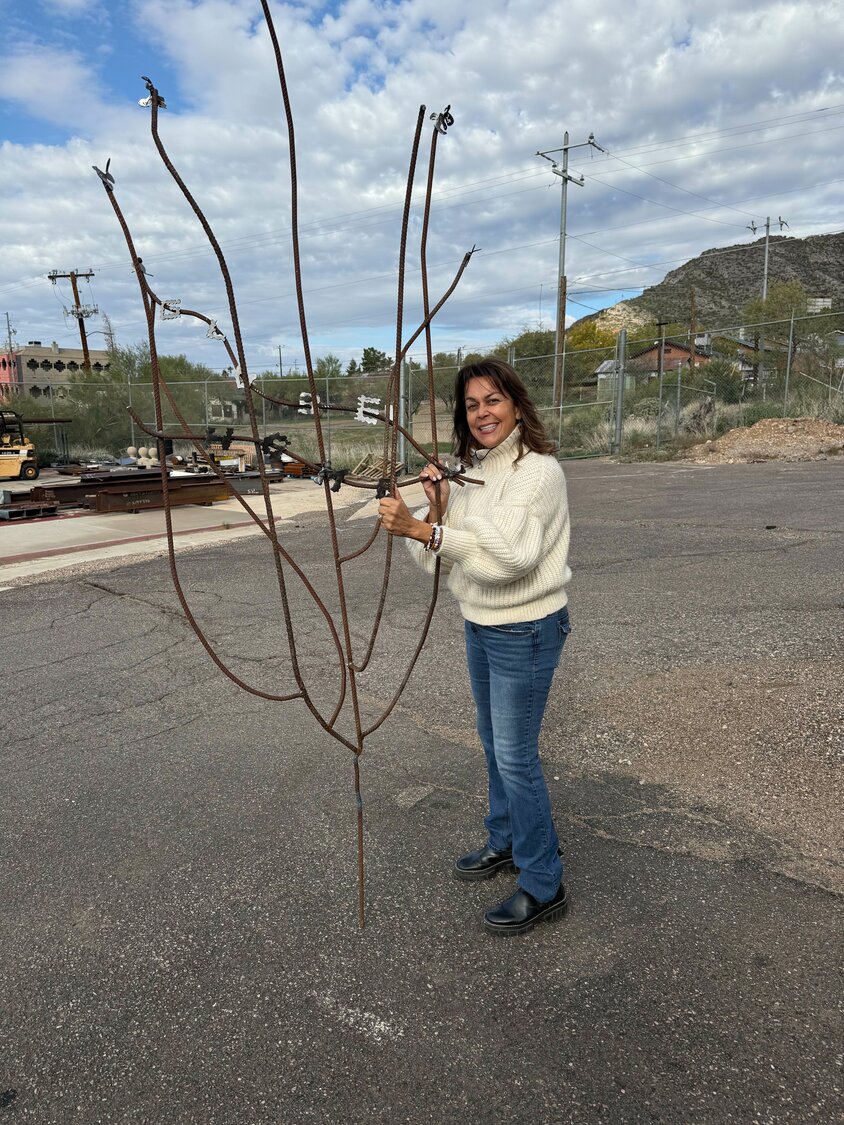


Just as metal joints are soldered to full strength with flame, so too are the connections between rural communities in the Copper Corridor shaped with grit, tenacity and … art. The welding program at the Superior Enterprise Center is the latest element to incorporate and demonstrate not only strength, but structural art.
Regina Ortega of Globe, co-creator with Thea Wilshire of Love Where You Live — the nonprofit that was the natural offspring of I ART Globe — said the duo has longed to inspire wonder and delight in every corner of the Copper Corridor, from Globe and Miami to San Carlos to Superior, Kearny, and Hayden-Winkelman, since their small beginnings in early 2020. Their efforts, which began in a very dark time for the community — and indeed the nation — during the pandemic, and more locally, the flooding that followed the fires of 2021, turned stairways, trails, and walkways into open-air galleries of murals and landscape art in Globe. As of the current count, the Trail features 90+ works of art and attractions.
After watching a variety of artists paint, spray, and create over four years, Ortega decided this year it was time to flex her own artistic muscle. When she heard about the Introduction to Metal Art class, she said, “Sign me up!”
Superior Enterprise Center and the welding program
The Superior Enterprise Center is a multi-generational center on the western side of the Copper Corridor. Superior has long been identified as a mining town, but according to Arlynn Godinez, the center’s director, the town just happens to have a mine — or six. Its identity, she said, is much more than that.
The welding program was developed to prepare students with real-world skills they need to enter the workforce. While the initial mission focused on preparing students in the Superior area, the vision is to expand to the entire Copper Corridor so anyone who wants to learn how to weld, whether for a job or for artistic pleasure, can do so in Superior.
Godinez said instructor Stan Schepers gives students hands-on training that teaches welding techniques alongside safety practices and job readiness.
Students can earn two certifications through the Enterprise Center: the Bend Tester and the NCCER certification. The first generally takes about two semesters to complete and can help students get a foot in the door for a job, where they will then need to test and re-certify. The second is a more intensive program that meets twice a week and, according to Godinez, “carries some weight in the industry.”
Both programs were designed in direct alignment with industry standards.
When students complete the program, Godinez said the instructor helps them make connections with hiring entities and often writes reference letters. The center recently hosted a reverse mining expo with Arizona at Work.
“We do all that we can to help line people up with jobs,” she said.
Mayor Mila Besich believes the Superior Enterprise Center is at the heart of the town’s innovation and resilience because it represents how Superior turns challenges into long- term opportunities.
Like so many mining and rural towns, Superior has faced its share of boom and bust, and the cavernous school building that now houses the Enterprise Center could have become just another blighted structure holding memories of better days.
“Instead of waiting for a single employer or an outside solution, we invested in a place that helps our residents build their own future,” Besich said. “The Enterprise Center is a former school building reimagined as a hub for entrepreneurship, workforce development, arts, and small business incubation. It reflects our belief that resilience comes from diversification and local talent.”
In addition to the welding center, the Enterprise Center is home to a technology hub called The Hive, a free and inclusive space where community members can build digital skills and sign up for a variety of classes and workshops. Visit superiorenterprisecenter.com/the-hive for information on free one-on-one technology help, robotics equipment availability, Internet access, and operating hours. The Hive was developed in partnership with the Institute for Digital Inclusion Acceleration and is the only rural Hive in the state, according to Godinez.
Small businesses and entrepreneurs can also visit: superiorenterprisecenter.com/resources for help starting, developing, and accelerating their ideas.
“The Enterprise Center also shows how Superior leads with creativity and partnership,” Besich said. “We repurposed an existing asset, leveraged public-private partnerships, and aligned the center with our broader revitalization efforts — from downtown redevelopment to tourism and trail investments. That integrated approach has helped us build an economy that’s flexible, locally driven, and better prepared to adapt to change.”
Love Where You Live and Ortega’s welding project
Just as Superior was planning to expand its offerings eastward in the Copper Corridor, Ortega and Wilshire were looking westward with their own brand of sharing. This time, Ortega was doing more than organizing and directing artists.
She was the artist.
Vernon Perry donated rebar from a project his son was working on in southeastern Arizona, and after enrolling and participating in classes, Ortega felt ready to try her Hand.
Because she was trained so thoroughly — and had a professional guiding her in class — she felt confident she could pull off her design: an ocotillo with blossoms and the words “Globe” and “Home” at the top.
“I was intimidated at first,” she said.
The piece was heavy, and Ortega had to learn how the base would support the top, how she would transport it safely, and the specifics of welding the metal joints.
And she did.
She also realized there was more she wanted to learn and plans to sign up for a more advanced class to tackle the technical aspects of welding and further hone her craft.
Ortega said having experienced welding art students in the class made the experience even richer, and she was able to learn from them as well as from the instructor.
Her ocotillo art — about seven feet tall — celebrates the area’s desert landscape. She hopes to donate it to the City of Globe to be placed along a trail on the Stairizona route.
“I like the idea that it is rooted and blooming,” she said. “It speaks to our region. We are able to come out of darkness and end up with something hopeful.”
The project is not yet finished. Ortega hopes to add color to the blooms.
What’s next for Love Where You Live?
Love Where You Live is gearing up for a new and exciting project.
The nonprofit has partnered with San Carlos, allowing it to apply for funding alongside Native American tribes, and it also received a $22,000 grant from Cobre Valley Regional Medical Center to create sculptures for the walking trail near the hospital.
The funding will allow Love Where You Live to issue a call for artists at a higher level than anything it has done before, Ortega said.
“This is not our first call to artists,” she said. “It’s going to be a lot of work. We say, ‘It’s going to be so easy,’ and then we laugh.”
The sculptors — mostly, though not exclusively, local — will be paired with professional sculptors to create works for the Medical Center trail.
Look for the Call for Artists from Love Where You Live toward the end of January 2026.
Globe’s Stairizona Trail received the 2025 Best Arizona Cultural Preservation Award at the Arizona Governor’s Conference on Tourism.
CORRECTION:


Comments
No comments on this item Please log in to comment by clicking here