

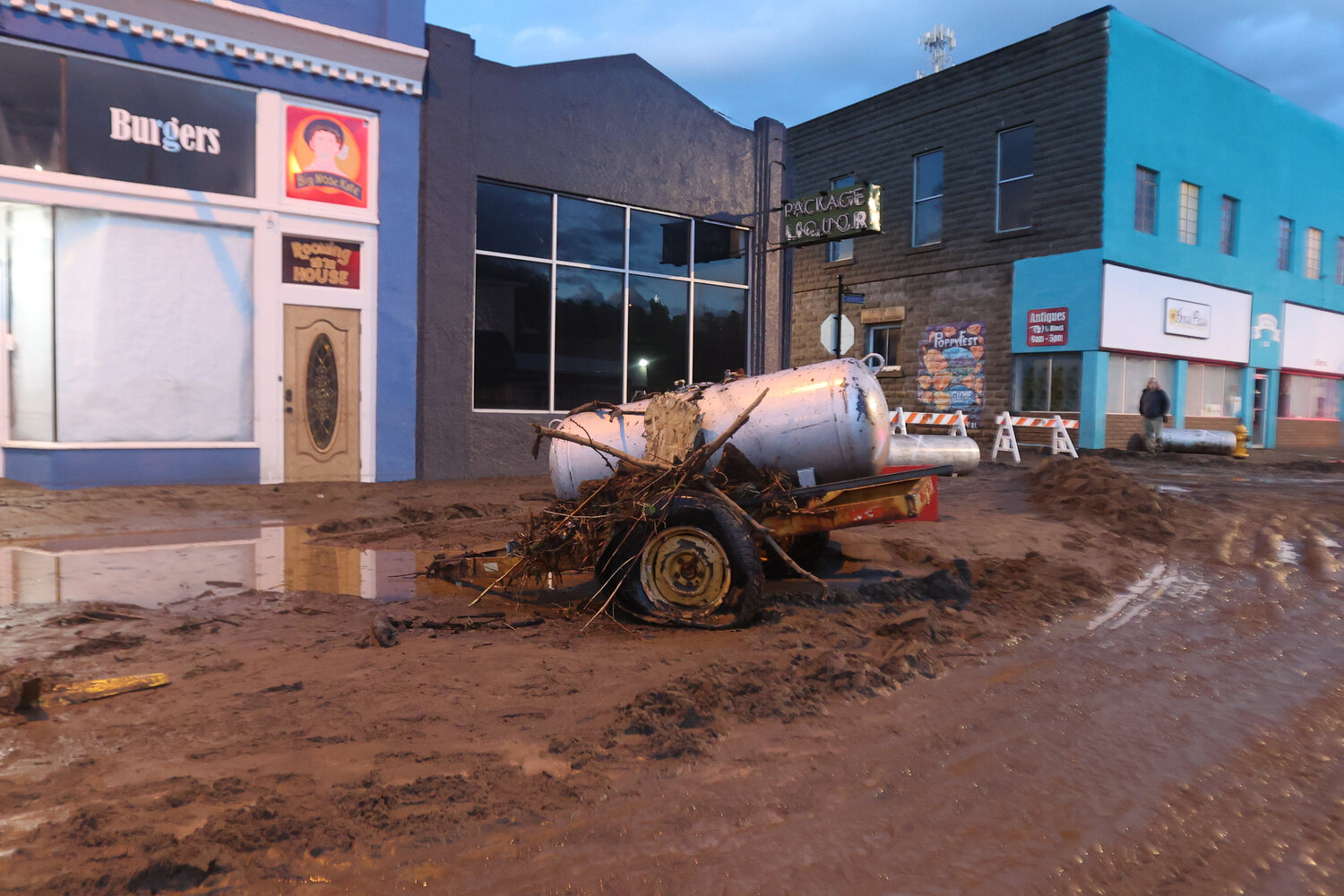


In the aftermath of the great flood of September 26, one of the images that will be burned in the memories of Globe survivors is hundreds of propane tanks washing through town on the raging waters of Pinal Creek.
The tanks came from the Matlock Gas property on Jesse Hayes Road, a sliver of land abutting the creek under Gila County's jurisdiction.
But nature does not recognize political boundaries, and on the night of the flood, an estimated 1,000-plus tanks were violently torn from the Matlock property and hurtled toward downtown Globe on a torrent of debris-filled water. Some were washed away as far as 15 miles to the Wheatfields area.
Many of the tanks were new and had no traces of gas in them, but there was enough residual gas in the out-of-service tanks that the air that night was tinged with the odor of propane.
“Some had content, and when we were walking downtown, you could smell the smell of propane,” says Mayor Al Gameros, who was working with emergency responders in the wake of the initial flood. “It was not a whole lot, and not really a threat for hazardous [material], or for explosion... These didn't have that much in them.”
The monumental task of cleanup began within hours of the waters subsiding, including gathering propane tanks and returning them to the Matlock property, but with the threat of more storms looming — there were three lesser floods in the following weeks — the City of Globe was concerned that the tanks needed to be moved to higher ground.
Matlock Propane & Equipment — AKA Matlock Gas — has operated on its current site for at least 88 years, but probably more.
According to Earl C. “Buff” Cunningham III, Matlock was established by his maternal grandfather J. Dee Matlock. Originally an electrical company, Matlock eventually switched over to propane. Buff Cunningham is the third-generation proprietor.
Although he now lives in Safford, Cunningham grew up on Pinal Creek and has never seen flooding like that in his 73 years. He says previous floods have rarely even risen to the level of the property.
He calls what happened a “tsunami,” adding that the subsequent floods were never a threat.
“If we had things built up off the ground or had steel containers or anything, I don't know if any of it would have made a difference,” he says. “I wasn't here when it happened. I didn't get here for three or four hours after we got notification, but it was pretty bizarre, and there was a lot of property damage, a lot of equipment damage.”
Faced with the prospect of cleaning up, Cunningham enlisted the help of members of the Arizona Propane Gas Association and hired contractors.
He estimates it took about 20 hours to get the rogue tanks out of downtown Globe, and most of the more easily accessed tanks took about five days, but chasing down the far-flung, often half-buried remaining tanks took about eight days.
The recovered tanks were initially returned to the Matlock property, but with the threat of more rain, city leaders decided they had to act to ensure the safety of Globe residents.
On Oct. 9, the City of Globe signed an emergency agreement with Matlock — a right of entry permit — in order to access the property to remove the tanks from the Jesse Hayes location.
“The propane tanks were removed and were relocated to a higher ground area,” Gameros said in a statement released Oct. 11. “This protective measure was initiated by the city with Matlock Gas with consultation from Gila County in anticipation of the upcoming storms, to protect life safety, property, and the environment.”
City property on Oil Circle Road, across Jesse Hayes Road from the Matlock property, was seen as a quick and convenient place for the tanks.
“We directly hired the contractors to remove them, because we needed to get it done,” Gameros says. “We wanted them out of there before another flood came.”
While the city absorbed the cost of moving the tanks to higher ground, the conversation between the Globe, Cunningham, and Gila County for the ultimate destination of the tanks remains to be seen.
“It's an ongoing thing. Those will have to be removed by Matlock to another location,” Gameros says. “But they're safe, they're secure, they're out of the way, and that's what we had to do.”
Questions remain about who will have the final say on where the tanks go, or if the Arizona Department of Environmental Quality will have to get involved.
Ultimately, Gila County has jurisdiction over the property.
“The county is working with the Matlock property owner(s) on near-term stabilization and longer-term mitigation,” stated Joshua Beck, Director of Gila County Public Health and Community Services in response to inquiries by Globe Miami Times. “We’re concurrently reviewing all applicable regulations (FEMA/NFIP floodway criteria, NFPA 58 anchoring requirements for propane tanks, and local floodplain and fire-code provisions) to clarify authority at the county level and ensure any actions taken are lawful, effective, and coordinated with the City of Globe and ADEQ.”
“We maintain regular communication with ADEQ, and in this situation, FEMA as well, and will continue to coordinate as appropriate within their jurisdictional responsibilities.”
As to future flood mitigation measures, the county is continuing to assess the situation and will “coordinate agencies and available funding to address mitigation priority areas.”
“This was a complex weather event that affected several jurisdictions and private properties,” Beck stated. “Our primary focus right now is still ensuring public safety, restoring access, debris management, resource and donation management, and completing a thorough evaluation of impacts while we determine next steps.”
Cunningham appreciates working with Globe and Gila County and believes he should be able to continue long-term operations without ADEQ becoming involved.
Despite all the damage to the property, Cunningham says his company was back in business within three or four days after the flood.
“It was a mess because we got flooded out: pumps and motors, our houses, everything, but we were up and working,” he says. “Now we just need to replace all the tanks that we lost. Then we're going to get together with the county to see what they suggest.”
He also thinks something needs to be done about drainage on Pinal Creek.
“We've lived through a bunch of floods and we almost don't even get any water on this property,” he says. “But the real issue was, after that [Telegraph] fire in the Pinals, there's nothing to hold the water back.”


Comments
No comments on this item Please log in to comment by clicking here