
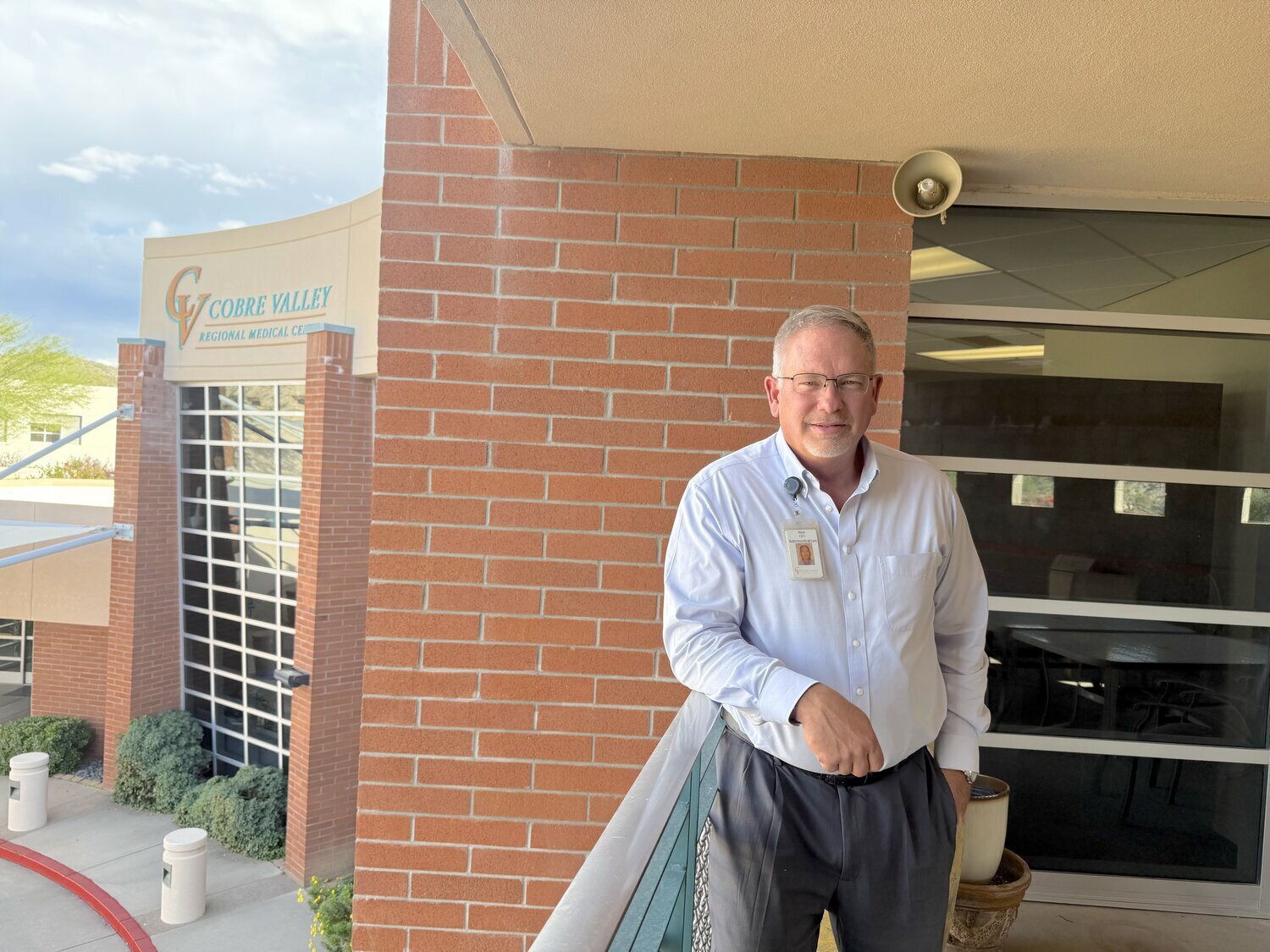
As the dust settles around the federal “One Big Beautiful Bill” and its far-reaching implications for rural healthcare, Cobre Valley Regional Medical Center continues to chart a steady course through uncertainty. While hospitals across the country brace for financial turbulence, CEO Neal Jensen remains focused and optimistic.
“We run lean and mean,” Jensen says. “There’s not a lot we can cut without impacting care, and that’s not something we’re willing to do.”
Despite headlines predicting widespread service reductions and closures in rural areas, that is not what’s happening at CVRMC. In fact, the hospital is still moving forward with plans to expand its walk-in clinic and build a new medical office building on campus.
Jensen says that while the financial picture is changing, it is not changing fast enough to halt growth or planning.
“If we do need to make cuts eventually, we will push out capital purchases, keep equipment longer, and look for other strategic projects we can do without. We will watch every dollar, but not reduce care,” he explains. “The big cuts don’t go into effect until 2027. Until then, we will use every tool available to prepare.”
Those tools, according to Jensen, include legislative advocacy, partnerships with national and state hospital associations, and a daily focus on efficiency.
Jensen and his team are deeply engaged in conversations at the state and federal levels, pushing for changes to reduce the bill’s impact on rural hospitals.
“There’s growing momentum in D.C. to soften the impact this bill will have on rural hospitals. Even some lawmakers who voted for it are now talking about amendments,” he says. “I’m confident there will be significant changes down the road.”
Jensen also points to Arizona’s Medicaid reimbursement rates, which are currently closer to covering actual costs thanks to a state-level provider tax. But if those funds are cut or not renewed, that cushion could disappear.
He says the hospital is preparing for that possibility with a multi-pronged strategy that includes grants, careful cash management, and exploring any new partnerships that make sense for the size and needs of the community.
When asked what areas might be at risk in a worst-case scenario, Jensen doesn’t hesitate.
“Most rural hospitals lose their OB programs when things get tight,” he responds. “But we’re not cutting ours. We’re one of the only providers in a large radius, and we know how critical it is for families here.”
Recruitment remains a challenge, but that isn’t new. Rural hospitals already struggle to attract and retain skilled professionals, and uncertainty around healthcare funding doesn’t make that any easier. But CVRMC is meeting the moment with local solutions.
“We partner with the local high school, college, and Cobre Valley Institute of Technology (CVIT) programs. We even help fund nursing instructors to increase the number of trained nursing professionals,” he says. “We also train students in radiology, pharmacy, respiratory therapy, physical therapy, and medical assisting. The goal is to train them here and keep them here.”
In addition, plans are in motion to develop a residency program to train primary care physicians locally.
The hospital’s response to recent public health concerns echoes its broader strategy of remaining community-focused and committed to trust. While national headlines swirl about changes to the CDC’s vaccine guidelines and committee membership, Jensen says CVRMC is holding steady.
“We’re not dumping our vaccine program. Most providers still recommend vaccination,” he says. “There’s a lot of confusion, but we’re continuing to offer routine and COVID vaccines, though demand has waned.”
Trust in public health guidance has become increasingly fragile in recent years. Jensen acknowledges the harm caused when institutions seem to backtrack or withhold information.
“When people feel like data is being hidden, they lose trust, and that makes compliance harder,” he says. “Older generations remember diseases like polio. That fear is gone, and with it, some of the urgency around vaccinations.”
He emphasizes that patients should discuss vaccines with their primary care providers and make those decisions together. They can receive vaccinations from their doctor’s offices and the CVRMC pharmacy since the local CVS Pharmacy has closed.
Yet another storm CVRMC has weathered is the flood that impacted much of Globe-Miami. The hospital was spared damage, but not untouched. They saw only one flood-related case, but several employees were directly affected.
“We donated to the United Fund, sent out workers to help, and did what we could to support our team and the community. Thankfully, we had flood barriers in place, but they were not needed,” Jensen says. “Our thoughts and prayers are with all those who were affected.”
Still, misinformation spread on Facebook that the hospital was inaccessible during the storm. Jensen urges residents to turn to official channels for accurate updates.
“Check our website and our social media pages. That’s where the truth is. Not Facebook rumors.”
The recent government shutdown has had little impact on CVRMC, though processing delays for Medicare and Medicaid claims and applications are expected. With cash reserves in place, the hospital is prepared to weather temporary interruptions in reimbursement.
Jensen expresses gratitude to the staff and providers who continued to show up during the recent flooding, as well as to the broader community for its ongoing support.
He urges residents who are concerned about Medicaid changes or the future of rural healthcare to speak up.
“If you’re concerned, write your legislator. Share your story. That’s how change happens,” he says.
“Legislators really do want to see hospitals thrive,” he adds. “We’re here for the long haul, and we’re going to keep showing up.”


Comments
No comments on this item Please log in to comment by clicking here