


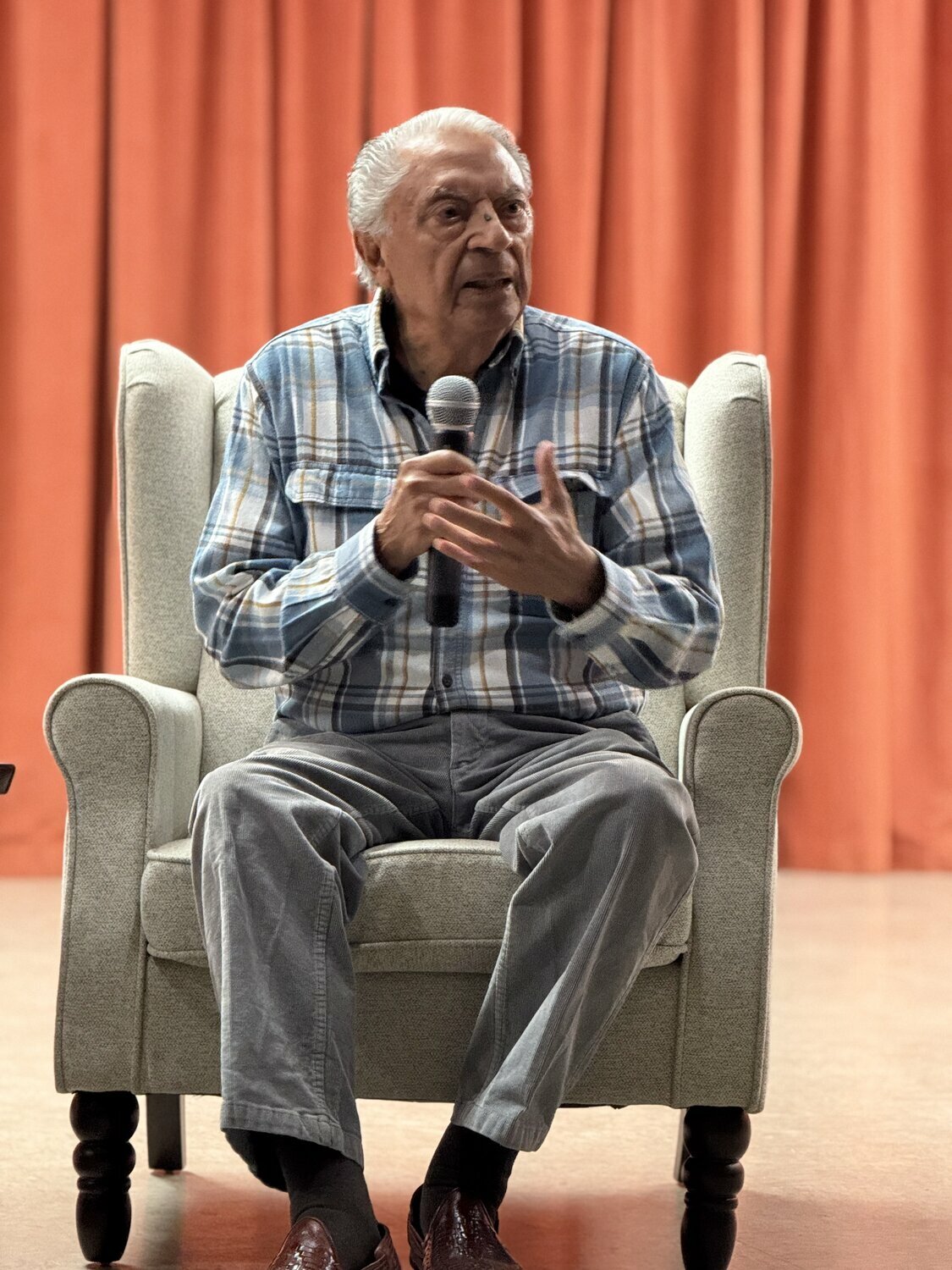


Dozens of community members gathered at the gym of the Bullion Plaza Cultural Center and Museum on Nov. 14 for “Miami Remembers!” — a roundtable discussion led by former Miami residents Roberto Reveles and Mike Santellanos.
Both men, sons of Mexican immigrants and graduates of the Miami High School Class of 1951, returned to share stories of segregation, community, war and the formative experiences that shaped their lives.
Boom years of downtown Miami
During their upbringing in Miami, downtown Miami was a booming town, Reveles and Santellanos said.
It was a time when one could find a “Mexican bakery, tortilla factory, and beverage bottling works all within one block,” Reveles said.
The speakers recalled the Mansour brothers, from the Middle East, who opened clothing stores, as well as the Greek family that opened the Lyric Theatre.
They also remembered “Bank Night,” a lively monthly event when the street would be closed from the Guayo’s El Rey area to Miami Town Hall. One community member would win a lottery.
These were times when businesses lined the street, including grocery shops and a market, the local theater, jewelry and furniture stores, a record store, a barber shop, the YMCA, and the Mexican YMCA.
“Mexicans were allowed to swim on the day before the pool was drained and cleaned,” Reveles added.
Division with segregated schools
Sitting in what was once Bullion Plaza School, the two reflected on how it was once a school designated for Apaches, Mexicans, and Mexican-Americans.
Segregation was based on a thesis by Stanford University professors who believed Mexicans were “inferior” and needed a special form of education, Reveles explained.
In this area, discrimination was prevalent, and Mexicans were almost “non-citizens,” he added. At church, the left side was designated for the Mexicans, and also the balcony of the theater.
“Even though division was going on in town, we never felt it in school,” he says. “Sometimes we got a little rap on our knuckles for speaking Spanish.”
At that time, high school was not mandatory, but it was encouraged. Miami High School was integrated at that time.
Teenage years
Santellanos recalled working at a shoe-shine stand in his early teen years. He said the owner was Arthur James Hawkins, “a kind, black gentleman from the South” who would take them out on his fishing boat once a month.
When Santellanos was 14, another shoe-shine stand came for sale. Hawkins told him that $50 would pay for the stand, the shack, the cash register, and the radio. He asked his father for the money, but was told he didn’t have it.
Instead, his father took him to Valley National Bank, where he got a co-signer for a $50 loan. He was now the proud owner of his own shoe-shine stand, and when Santellanos was in school, it was run by his uncle and cousin.
Santellanos also reminisced about the MHS basketball team of 1951. He said he sold the shoe-shine stand to follow the team and hitchhiked to all 27 games, and his friends who were players, Rudy Moreno and Fito Trujillo, would let him sleep on the floor of their motel rooms. He believes he is the only Vandal fan who didn't miss a game.
Careers that began in Miami
Santellanos and Reveles went on to describe their experiences in the Navy, in college, and in their careers. Both credited the education and skills they gained in Miami to their careers, which took them all over the world.
Reveles worked in Florence, Italy, while Santellanos helped open offices in Guatemala and Costa Rica. Santellanos was the first Mexican to become a partner with Price Waterhouse World Firm. Reveles was a U.S. congressional staffer for 24 years.
“These journeys began in this community, an area that provided the first governor of Arizona, Governor Hunt, and the first female governor of Arizona, Rose Mofford,” Reveles said. “Great people have come from our community, including Santos Vega, a U.S. citizen whose family was deported to Mexico.”
“I saw history, and sadly, I’m seeing history repeat itself,” he added.
Remembering Miami when the country was at war
Reveles was asked about his experience on Dec. 7, 1941, when he was about 8 years old.
"I was living on Nash Avenue, and all of a sudden I heard people crying,” he recalled. “I heard the radio turned up — Japan had just attacked Pearl Harbor."
He said neighbors immediately began volunteering and enlisting in the service.
"It changed the environment at Bullion Plaza. We wanted to do our part,” he explains. "We set up a kiosk with a big display of the leaders of Japan and Germany. Our classmates bought imperial defense stamps and would compete to see whose photo would be covered first."
Locals also collected lead from the creek beds that was dumped by The Silver Belt newspaper, he added, and it was sent off to be made into artillery.
The Miami-Globe area became a high-industrial target, Reveles said.
He described the air-raid sirens, how people were put on patrol, and how blackout shades were put on windows. Convoys of prisoners of war from Germany were driven in open-bed vehicles, and the kids would gather to throw rocks.
Meanwhile, Japanese citizens were transported from California to Arizona to three internment camps in Mohave County, Pinal County, and Central Arizona.
Because of people enlisting in the military and leaving the area, manpower was in short supply. Mexicans and women were permitted to work in the mine. Everyone pitched in to do whatever was needed to defend the country.
Looking back
Despite discrimination and hardship, Santellanos said he remembers Miami fondly.
“This was a booming town,” he concluded. “It was fun to live here in spite of the difficulties. I remember all those good things.”


Comments
No comments on this item Please log in to comment by clicking here