
Attendance by members of the Globe City Council: Mayor Al Gameros, Vice Mayor Mike Stapleton (District 4), and Council members Freddy Rios (District 1), Mike Pastor (District 2), Jesse Leetham (District 3), Mariano Gonzalez (District 5), and Fernando Shipley (District 6). Councilman Fernando Shipley was excused.
During its Feb. 10 meeting, the City of Globe City Council focused on flood mitigation planning and advanced funding plans for major infrastructure repairs, namely sewer and water projects. Council also approved a return-to-work framework intended to preserve institutional knowledge within the city.
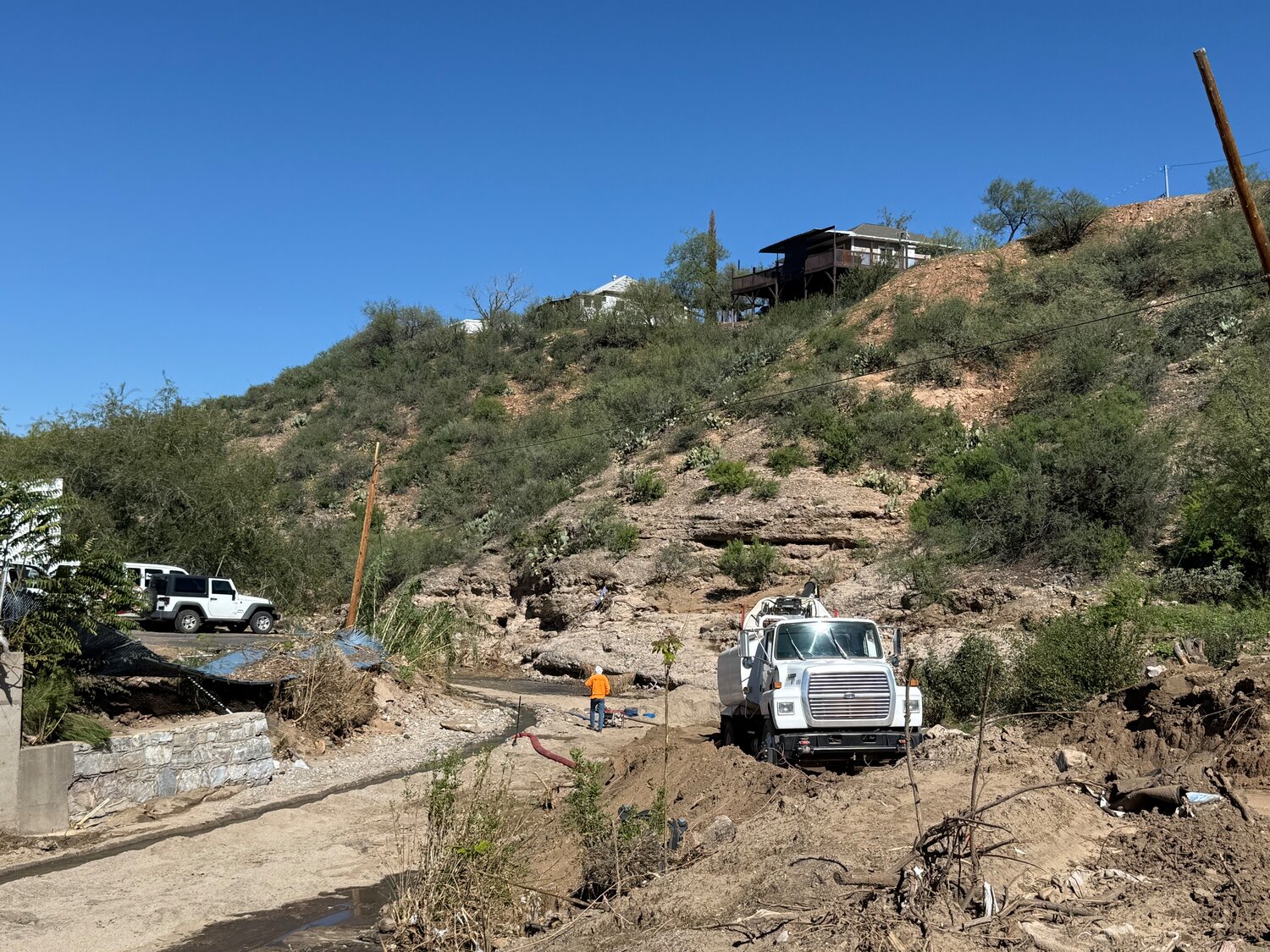
Globe Fire Chief Gary Robinson presented a detailed update on federal funding the city is receiving through the Natural Resources Conservation Service to support flood mitigation work along Pinal Creek and surrounding waterways.
The city’s application for approximately $24.77 million has been approved. The funding comes with strict requirements, including a 220-day deadline for project completion. The clock began running on Jan. 30, which means the deadline will occur in early September.
The first visible phase of work is already beginning. Residents may notice activity related to aerial mapping, which will include a low-flying manned aircraft (not drones) operating at approximately 1,000 feet above Pinal Creek and the Russell Gulch and Six-Shooter area. The aircraft will collect high-resolution data, supported by ground markers.
The goal is to compare new mapping data with historical records to determine how much sediment has accumulated, where sediment has been deposited, and how channel elevations have changed. This information will guide sediment removal and channel restoration work intended to restore water flow capacity and reduce future flood risk.
“It’s important that residents understand how important this project is. … We’ve got to get this project done, because we’ve got to make sure that if it rains like it did before, that our water will flow and not damage all these businesses again, or residents, that they put so much money back into.” — Globe Mayor Al Gameros
In addition to aerial mapping, crews will conduct ground surveys to establish channel widths and property lines to ensure private property rights are respected during construction.
Of the total funding, just over $3 million is allocated for technical assistance, covering engineering, mapping, surveying and project design. This portion does not require a city match, allowing early-stage work to proceed without immediate funding obligations for the city.
Chief Robinson also discussed the need for the city to secure Right of Entry agreements from property owners along the affected corridor. The city needs ROEs for 74 residential, business, and small commercial parcels. This does not include larger landowners such as the railroad and mining companies, which are being contacted separately.
As of the time of the meeting, 29 ROEs had been submitted, and additional submissions were expected in the coming days. Remaining property owners will receive certified mail along with a letter from the mayor.
“Our message has always been, we need your help. … The faster we're able to move, the more cooperation we receive, the better we can make that, the more we can achieve.” — Globe Fire Chief Gary Robinson
Temporary construction easements may be required for sediment removal, and longer-term drainage easements could be necessary for ongoing maintenance.
Chief Robinson stressed that cooperation from property owners is essential to keep the project on schedule. Without access to certain properties, the scope and effectiveness of the work could be affected. If a key parcel owner were to refuse access, city leadership would need to evaluate next steps based on how significantly that property affects the overall project.
The NRCS funding operates on a 75% federal, 25% local match basis for construction work, not including the portion of the money designated as technical assistance. As a result, if the city were to use the full eligible amount of just under $24.75 million, the required match would be roughly $5 million.
The funding is structured as reimbursement, meaning the city must expend funds up front before receiving federal repayment. NRCS reimbursements are typically faster than other federal processes, such as those through Arizona’s Department of Emergency and Military Affairs. The city must still manage cash flow carefully.
City Manager Paul Jepson acknowledged that while the match funding is a challenge, the larger constraint may be the tight timeline. If necessary, the city could scale back work to fit within available matching funds, but Jepson expressed confidence that multiple funding sources could be combined to meet the local match requirement.
Council is authorizing the city to apply for two multimillion-dollar loans through the Water Infrastructure Finance Authority of Arizona. The first, a $4 million Clean Water State Revolving Fund loan, aims primarily at addressing major sewer infrastructure needs, and the second is a $2 million Drinking Water State Revolving Fund loan that would support the waterline replacement to the fairgrounds.
Jepson explained that recent flood damage has exposed significant vulnerabilities in the city’s sewer system, including approximately 2.7 miles of line that require replacement and multiple manholes needing repair. Emergency work has already restored basic function, at a cost of roughly $1.2 million, but camera inspections show structural damage, broken lining, and exposed pipe within the creek corridor.
Funding from the Federal Emergency Management Agency is being pursued and, if approved, could cover 90% of sewer repair costs over an 18-month period. However, the scale of the project and tight timelines make it unlikely that all needed work could be completed within that window.
The proposed WIFA loan would provide the possibility to continue repairs beyond FEMA’s timeframe and to address additional sewer projects that were delayed when enterprise funds were redirected to emergency repairs.
“This is part of our strategy to make available as many options as possible for funding, not knowing what the future brings.” — Globe City Manager Paul Jepson
Of the $4 million requested for the sewer work, approximately $2 million would serve as contingency funding for urgent or reactive sewer repairs, while the remaining $2 million would support planned common-line sewer projects and a sewer master plan study. The funds would be available for three to five years, giving the city flexibility in when to spend it.
The Clean Water State Revolving Fund loan is intended to provide flexibility in light of mounting infrastructure demands and ongoing flood recovery costs.
A key project tied to this request is the waterline replacement to the fairgrounds. That project involves federal funding through the U.S. Army Corps of Engineers, and the city is responsible for a 25% local match on that project — approximately $700,000. Part of the WIFA loan, if approved, would be used to cover that obligation.
Jepson noted that significant water system funds have already been redirected toward flood-related repairs, and the loan would help ensure that water infrastructure projects can move forward without freezing other city priorities.
Under a new third-party employment structure approved by council, city employees who are nearing retirement will be able to retire and return to work.
The arrangement allows employees who qualify for retirement under the Arizona State Retirement System to formally retire, begin drawing their retirement benefits, and then return to work through Educational Services LLC (ESI), which will serve as the employer of record. The employee becomes a W-2 employee of ESI rather than the city, while continuing to provide services to Globe under contract.
Jepson said the model has been widely used in school districts since the late 1990s and is similar in concept to “drop” programs commonly used in police and fire departments. The structure provides a transitional pathway for experienced employees who may not be seeking promotions but want to continue working while accessing retirement benefits.
“What we can't make up in raw salary, we can make up in quality of life and work-life balance and these types of creative and alternative arrangements that help our employees meet their family needs, their personal needs, and so they can stay working.” — Globe City Manager Paul Jepson
Council approved an employment services agreement with ESI under which the city will pay ESI a flat contracted rate covering salary and administrative costs. ESI will handle payroll and benefits for participants, and does offer group health insurance.
The city would no longer directly provide health insurance or standard employee benefit packages for those participants, which will help keep overall employment costs stable. Jepson noted that many eligible employees are already Medicare age and may choose alternative health coverage. Participants would be employed at-will by ESI, with a minimum one-year contract and no severance provisions.
Jepson emphasized that council’s approval of the agreement with ESI does not automatically place any specific employee into the program. Instead, it creates an option available to all eligible city employees.
Council approved a change to the date for the city’s 2026 primary election to align with a recent change in state law.
City Clerk Shelly Salazar explained that Governor Katie Hobbs signed legislation moving Arizona’s primary election to the second-to-last Tuesday in July. As a result, Globe’s 2026 primary election will now be held on July 21, 2026, with the general election remaining scheduled for Nov. 3, 2026.
The change also shifts related deadlines. Voter registration for the primary will close on June 22, 2026, and the candidate filing period will run from February 21 through March 23, 2026.
Jepson noted that the statewide adjustment was made to allow additional time for election challenges and appeals, ensuring compliance with federal deadlines, particularly for military and overseas voters.
Globe Police Chief Dale Walters and council recognized Detective Devin Meintzer of the Globe Police Department for 20 years of service, a career Chief Walters described as “defined by dedication, integrity, and unwavering commitment to his community.”
Det. Meintzer started as a patrol officer on the front lines, and was promoted to patrol sergeant — where he mentored and guided other officers — and then detective. Chief Walters praised Det. Meintzer for his professionalism, sound judgment, and a strong sense of responsibility.
Mayor Gameros provided an update on Copper Mountain Transit. Globe’s annual contribution will remain at $70,000, with Gila County and the Town of Miami also making $70,000 contributions.
The transit system recently received a new, larger bus through grant funding, and a letter of support has been submitted for an additional grant application. Ridership remains steady, particularly on Hill Street.
Councilman Pastor raised the possibility of expanding service to the Wheatfields area and suggested the transit board consider this at a future meeting, which Mayor Gameros agreed to do.
City Manager Paul Jepson will be staying on for at least two more years after council approved an extension to his employment agreement, which also aligns it with the newly adopted return-to-work framework.
The payment mechanism of Jepson’s contract will be adjusted to match the ESI model approved earlier in the meeting. Under the arrangement, he will formally retire and return to work through ESI for the first year, with flexibility to adjust the structure in the second year, depending on the city’s needs.
Council also approved motions for the following:
To view this meeting online, click here: City Council Meeting - February 10, 2026.
To view documents related to this meeting, click here.
Full minutes can be found by going to the city's website at https://www.globeaz.gov/government and clicking on agendas/minutes in the bottom left-hand corner.
The Globe City Council meets every second and fourth Tuesday of the month at 6:00 p.m. at Globe City Hall.
Members of the public can also participate in City of Globe public meetings by viewing the meeting live on YouTube. To view the council meeting live stream, go to the City of Globe’s YouTube channel or click on the “Live Stream on YouTube” link at the top of www.globeaz.gov.
If you desire to speak to the council during an agenda item, you can call or text (928) 200-0154 or send an email to council@globeaz.gov.


Comments
No comments on this item Please log in to comment by clicking here